


Related Posts
- ▶ How does axle placement affect semi trailer load distribution?
- ▶ How to choose dump trucks for steep haul roads
- ▶ What causes excavators to lose hydraulic power?
- ▶ How to read load charts for truck cranes
- ▶ How to check used truck cranes for boom damage
- ▶ What causes dump trucks to tip over during unloading?
Send Us A Message
How does axle placement affect semi trailer load distribution?
On semi trailers, moving the trailer axle group rearward generally transfers more of the trailer’s weight to the kingpin and tractor. Moving it forward generally puts more weight on the trailer axles. The direction is straightforward, but the usable payload depends on where the cargo sits, the empty trailer’s weight distribution, the tractor configuration and the limits that apply to the route.
Axle placement also changes turning behavior and rear overhang. A position that produces acceptable axle loads on the highway may create clearance problems at a loading site, so weight distribution and maneuverability need to be assessed together.
How axle position changes the load split
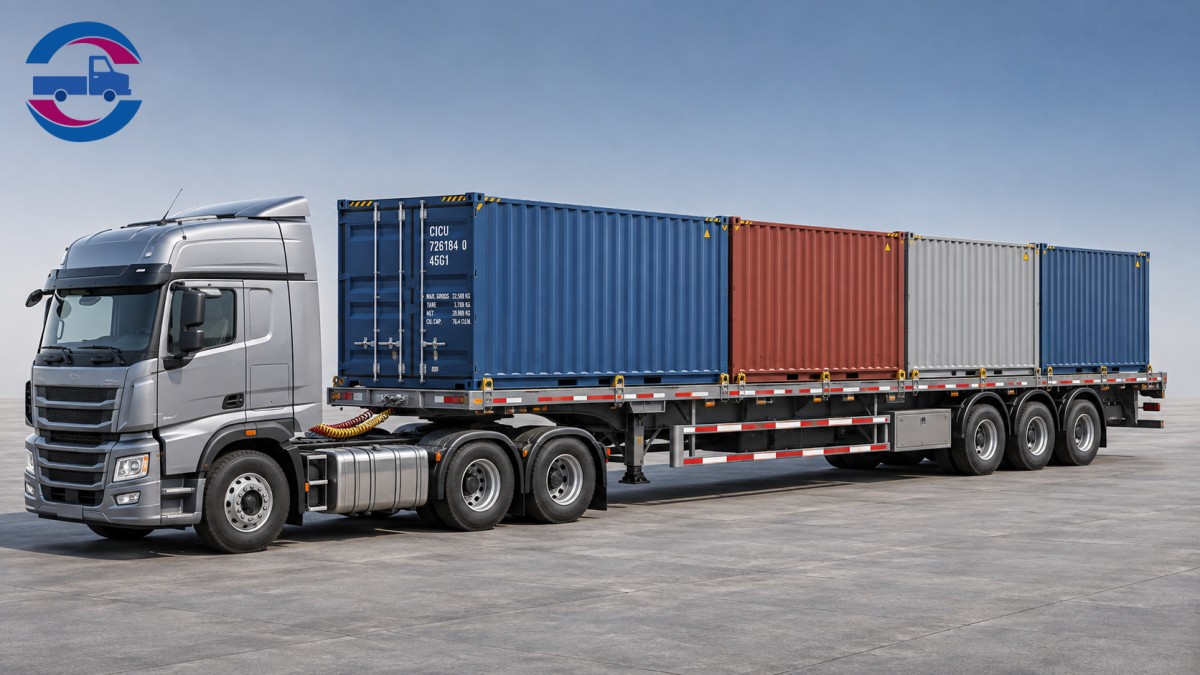
A coupled trailer is supported at two main points: the kingpin at the front and the trailer axle group toward the rear. The cargo’s center of gravity acts between—or in some cases beyond—those supports. The closer that center of gravity is to one support, the greater the share of the load carried there.
With the kingpin, cargo and trailer body held in the same positions, shifting the axle group rearward increases the distance between the supports. This generally increases kingpin load and reduces the load on the trailer axles. Shifting the group forward has the opposite effect. Moving cargo forward or rearward can produce a similar redistribution, even when the axle position is fixed.
Kingpin load does not pass entirely to the tractor’s drive axles. Its effect on the steer and drive axles depends on the fifth-wheel position relative to the tractor axles, as well as the tractor’s own weight distribution. A trailer-side calculation alone therefore cannot establish whether the complete combination is within its axle limits.
Using a load calculation to compare layouts
For a preliminary comparison, treat the trailer as a beam supported at the kingpin and the center of the trailer axle group. Combine the trailer’s empty weight and cargo weight at their respective centers of gravity. The load on each support can then be estimated by balancing the moments around the other support.
For example, if the combined trailer and cargo center of gravity lies halfway between those supports, each carries half of the combined weight in the simplified static model. If it moves closer to the axle group, the trailer axles carry a larger share. This calculation estimates total axle-group load; it does not establish the load on each individual axle.
Use actual dimensions and weights for each proposed configuration. For mixed or concentrated cargo, calculate the contribution of each load item separately or determine their combined center of gravity. A payload figure by itself cannot show whether the kingpin or an axle group will be overloaded.
Turning, overhang and operating conditions
Moving the axle group rearward generally increases the distance from kingpin to axle group. During a turn, the trailer wheels tend to track farther inside the tractor’s path, increasing the space needed around corners. Moving the group forward generally reduces that off-tracking, but leaves more trailer length behind the axles.
More rear overhang can increase tail swing: the rear of the trailer moves outward as the vehicle turns. That matters near loading docks, gates, roadside equipment and other obstacles. It can also affect ground clearance when entering ramps or uneven sites. Neither axle position is automatically better; the route and the space available at both ends of the journey determine which trade-off is acceptable.
For heavy equipment or other concentrated loads, check where the machine can be secured as well as where its weight needs to sit. An axle layout that works for evenly distributed freight may leave too little flexibility to position a machine while keeping both the kingpin and trailer axle loads within their limits. Deck strength, tie-down locations and clearance also constrain placement.
What to check before selecting a configuration
Start with the intended tractor, expected cargo weights and centers of gravity, loading positions, and the roads and sites the combination must use. Compare the calculated loaded and empty conditions against applicable axle, axle-group, gross-weight and dimensional limits, as well as the ratings of the tractor, trailer, tires and coupling equipment. Group limits and individual axle limits both matter.
If the trailer has a sliding axle assembly, account for the permitted adjustment positions and the manufacturer’s operating instructions. Sliding the axles can help redistribute weight, but it cannot increase a component’s rated capacity or correct every loading problem. Likewise, moving the tractor’s fifth wheel changes the distribution between tractor axles and may affect clearances; it is a separate adjustment from moving the trailer axle group.
Finish by weighing the complete combination in representative loaded conditions. Scale readings show how the actual cargo placement and equipment weights affect the steer axle, drive axle group and trailer axle group, giving a practical basis for adjusting the load or reviewing the configuration.
- Last One:No more articles
- Next Article:No more articles